

Wedding DJ Prices in Dallas -
5 honest truths
Back to Home Page
By Matt Thelen · Music Performance Degree · WIPA Board of Directors · Performing since 1998
Last updated: May 2026
Dallas Wedding DJ Prices: 5 Honest Truths
You start with a search. Within 5 minutes, you’ve seen $500, $5,000, and $15,000 cited as prices for a Dallas wedding DJ. Three numbers, one search, no clear way to tell what separates them or which one belongs to the wedding you’re planning. The questions stack up fast: What do these numbers cover? Why are they so drastically different? What should my budget be? How do I know if it’s enough to cover everything I want and need?
Dallas wedding DJ prices cover the full quality spectrum and reflect differences in scope, equipment, preparation depth, training, and demand. National averages understate the Dallas market because they aggregate part-time work and lower cost-of-living regions into one figure. The right number for any couple comes down to budget priorities and event needs.
Key takeaways
- Dallas wedding DJ prices range from $500 to $15,000, with the spread reflecting differences in experience, training, equipment, preparation depth, day-of scope, and the inclusion of live instrumentalists.
- National averages understate the Dallas market by roughly three to five times because they aggregate entry-level providers and rural regions.
- Figures found when searching for wedding DJ prices typically only cover the pre-event preparation and basic reception elements like day-of labor, sound equipment, MC duties, and music management through dinner and the dance set.
- Items like ceremony music, ceremony sound, cocktail hour music, reception instrumentalists, lighting, production upgrades, and rehearsal dinner coverage typically live outside the base DJ rate found from searches.
- A comprehensive Dallas wedding DJ budget can be assembled either à la carte (separate providers per line item) or consolidated under a single provider.
In this guide
- Where initial pricing searches fall short
- What the initial online figures actually cover
- What’s often not included in that number
- What influences the difference between $500 and $15,000
- Building a comprehensive wedding DJ budget
- Questions Dallas Couples Ask About Wedding DJ Pricing
- Featured Dallas Wedding Venues
- More Dallas Wedding DJ Resources
Where initial pricing searches fall short
The initial search results couples encounter tend to follow the same few patterns. None are wrong, exactly. They’re just incomplete in ways that leave couples without a usable framework.
The first pattern is the Google search. Type a question into a search bar and you’ll see a number, almost never with any explanation of what the figure is supposed to include. Reception coverage only or the whole day? Lighting? An MC? The number arrives without scope, which is the only context that would make it useful.
The second pattern is the industry site. The Knot, WeddingWire, and similar publications quote ranges or percentages without specifying scope. The ranges these sites publish are real. What’s missing is the detail about what each figure in the range actually covers. A price at the bottom of the range and a price at the top often describe entirely different services, but the published range doesn’t reveal that distinction.
The third pattern is the way the averages themselves are calculated. Industry-site figures aggregate data nationally, which means beginner and part-time DJs as well as weddings in lower cost-of-living markets pull the published average down. In major metros like Dallas, the real local average can run three to five times what national sites suggest. Anchoring to a national average in a Dallas market is anchoring to the wrong number from the start.
The fourth pattern is a standardized budget allocation percentage. You’ll see advice that wedding entertainment should run a fixed percentage of the total wedding budget, or some similar ratio. Percentage rules assume two fixed inputs: a fixed scope of services and a fixed level of priority for entertainment in the wedding vision. Both vary enormously couple to couple.
For couples whose entire vision rests on the energy of the reception and the dance floor, entertainment should run higher than the rule suggests. For couples prioritizing the visual elements like floral, design, and decor, it might run lower. A flat ratio treats every couple’s priorities as identical, when in practice those differing priorities are exactly what should determine the budget allocation.
The thread running through all four patterns is the same: numbers without context. The right next question isn’t “how much” but “for what.”
What the initial online figures actually cover
The numbers published online generally describe a specific scope of work: reception coverage by a DJ. Inside that base rate, five core items account for most of what a couple is paying for.
Pre-event preparation. The hours invested before the wedding day itself: initial planning calls, music curation and set list development, transition mapping, special-moment programming, timeline coordination with the planner, and ongoing client communications throughout the planning process.
Day-of labor. Everything from arrival at the venue through final load-out: setup of all equipment, soundcheck, the reception itself, and breakdown and strike at the end of the night. An assistant or second tech is typically on hand to accelerate setup and strike. The total time on-site runs well beyond the contracted reception hours.
Standard sound equipment for the reception room. Speakers, mixer, and microphones sized to the room.
MC duties during the reception. Introductions of the couple and wedding party, announcements throughout the night, and transitions between key moments (toasts, first dance, parent dances, cake cutting, exits).
Dinner and dance set coverage. Music management through dinner service, the energy build into the dance set, and the close of the night.
These components only cover a portion of the full wedding-day picture. A full wedding day has technical and creative needs that run across ceremony, cocktail hour, and reception, and the items in a DJ base rate rarely cover all of them. The remaining pieces are typically either add-ons available from the same DJ or separate line items a planner sources and budgets for from additional providers.
What’s often not included in that number
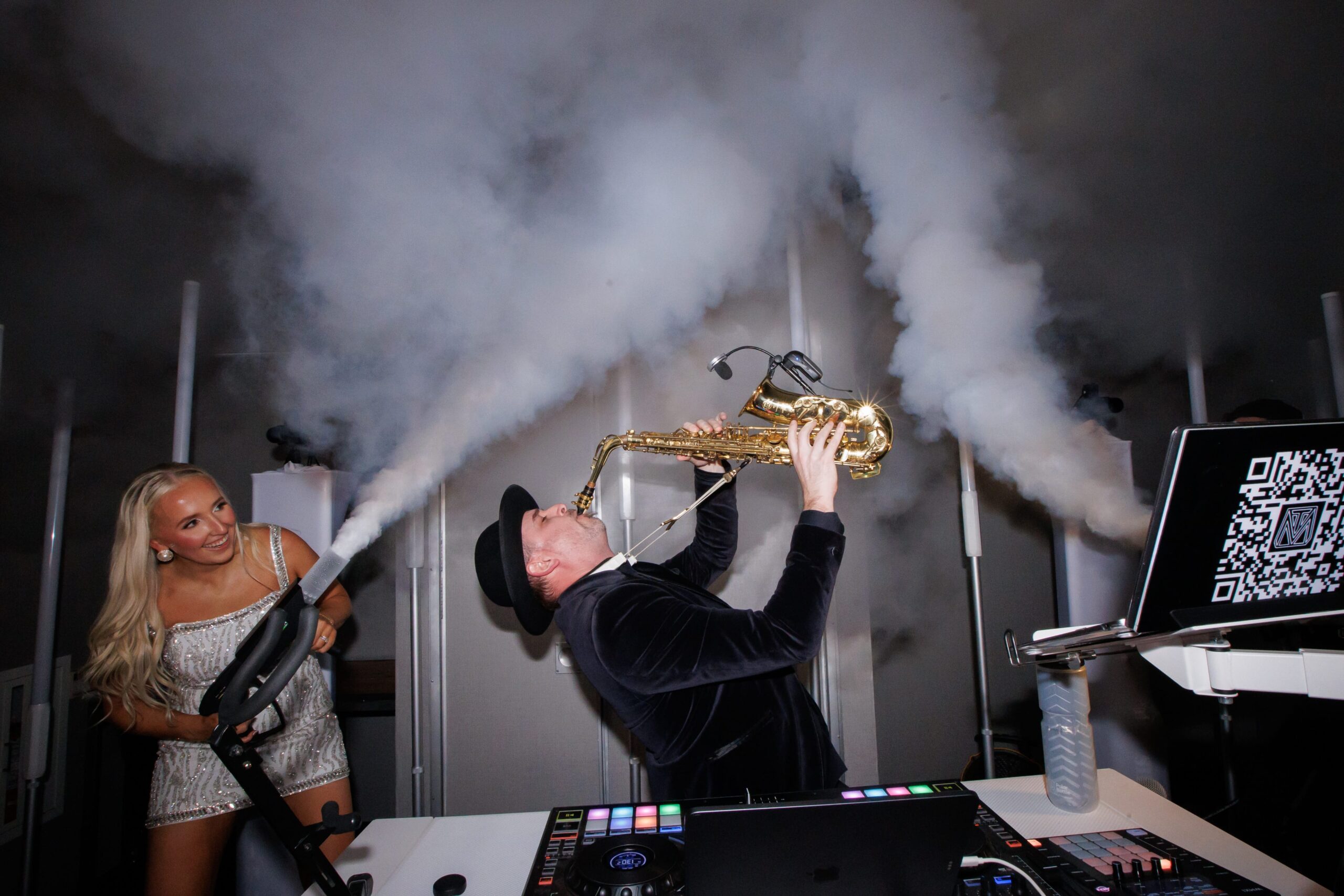
Live saxophone layered over DJ tracks. The signature Matt Thelen Entertainment Dallas wedding experience.
The items above cover a specific segment of the day: the reception itself. What surprises most couples is how many other parts of a wedding day aren’t covered by that initial number.
Ceremony music. Selection, curation, and the emotional arc of what plays as guests arrive and as the couple enters and exits the ceremony. Delivered as live performance or as a curated, DJ-managed playlist.
Ceremony sound. A separate service entirely from ceremony music. The technical layer that ensures the officiant, vows, and readings are heard clearly: microphones for the officiant and any readers, plus speakers sized to the ceremony space (indoor, outdoor, or both). Often handled by a different provider than the one supplying the music itself.
Cocktail hour music. The hour between the ceremony and reception – with either live performance or DJ coverage – sets the tone of the evening and impacts the way guests flow into the reception.
Reception musicians. Live instrumentalists who perform interactively on or near the dance floor during the reception, layered alongside the DJ. They move through the room and add live texture to the recorded tracks. Common examples include saxophone, strings, and percussion.
Lighting. Dance floor lighting and room uplighting. Often handled as one scope by a dedicated lighting provider, rarely included in a standard DJ quote.
Production upgrades. CO₂ cannons, lasers, and other effects that elevate specific moments of the night. Almost always add-on territory.
Rehearsal dinner. A second calendar date, with its own sound needs (speakers, microphones for toasts and speeches), and a creative choice between live performance or DJ coverage.
A DJ’s base rate typically only covers the reception – the items above are simply the rest of the picture. Identifying which of them belong in your wedding is where a real budget starts.
What influences the difference between $500 and $15,000
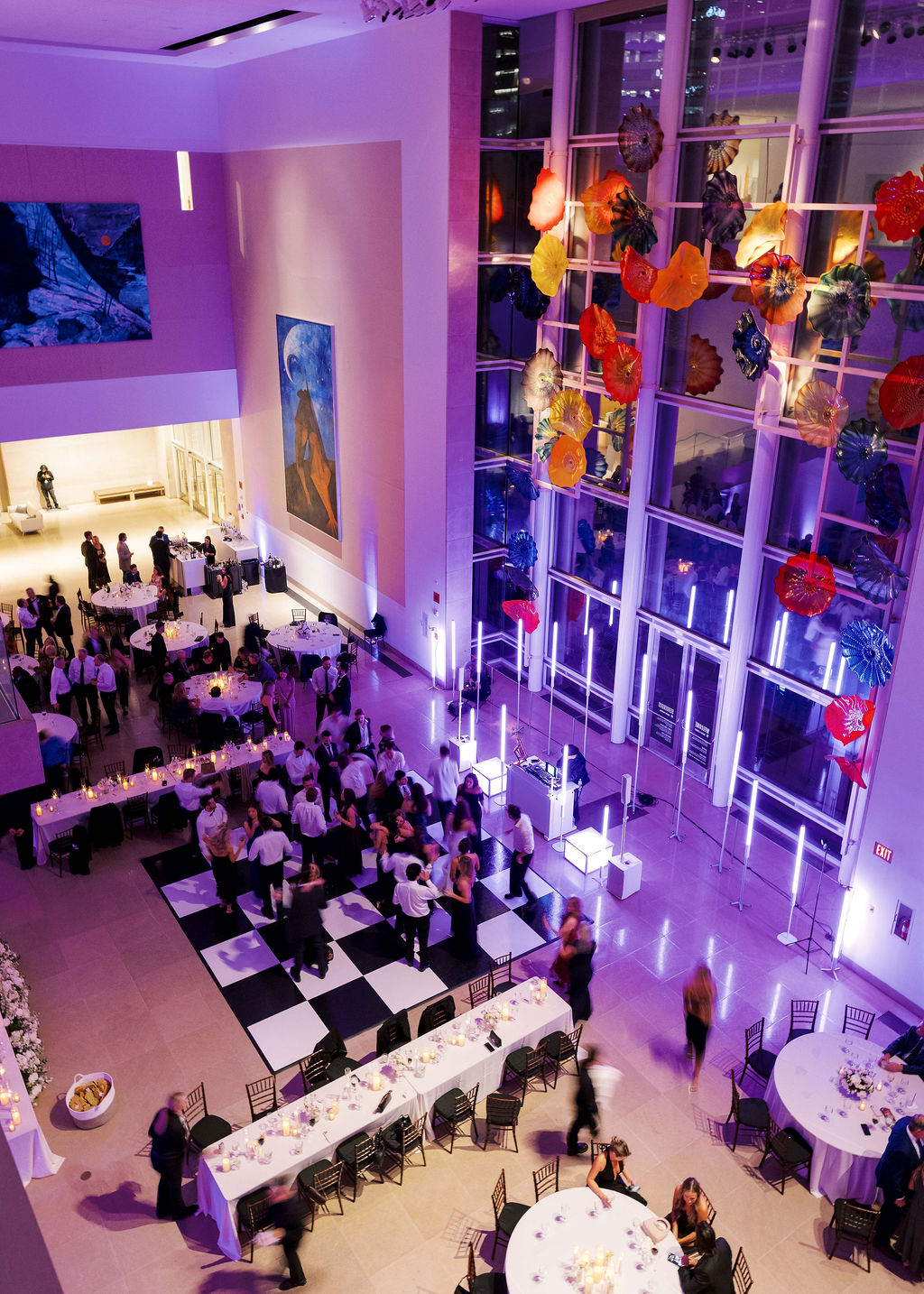
A full Dallas wedding DJ setup. Equipment quality, planning hours, and experience all factor into pricing.
The spread of Dallas wedding DJ prices across the market reflects real differences in what couples are buying. The factors below explain why two DJs can sit at very different price points and both be charging accurately for what they deliver.
Years of experience. How long the DJ has been working professionally. Years of wedding experience shape pattern recognition, comfort under pressure, and the depth of situations the DJ has already navigated.
Market demand. Highly-referred and frequently-booked DJs charge more because their calendars fill earlier. Demand is its own price lever, separate from years of experience.
Formal musical training. Whether the DJ has a music degree, formal performance training, or is self-taught. Different educational backgrounds shape different approaches to set construction, transitions, and timing.
Equipment quality, redundancy, and setup scope. The tier of speakers, mixers, and microphones; whether backup gear is on site; the visual presentation of the setup itself.
Depth of preparation per wedding. Time spent with the couple, set list building, transition programming, and planner coordination. This ranges from hands off – emails and questionnaires – to months of collaborative planning.
Live instrumentalists. Whether the DJ can perform live instruments themselves or bring on additional performers to enhance their set. Adding live musicians significantly changes the scope of the service and the cost structure required to deliver it.
Labor scope. Calendar days reserved (single date or rehearsal-plus-wedding) and which segments of the day are covered (ceremony, cocktail hour, reception, or full coverage).
Annual capacity. DJs who take 50 to 80 weddings per year deliver a different client experience than those who take 25 to 30. Both models are valid; the difference in time allocation and attention to detail greatly impacts the client experience and the pricing model alike.
Overall impact on the wedding day. The direct effect a DJ has on the energy, flow, and memorability of the event. This is the hardest factor to evaluate before booking, but it’s often the largest single price driver across the market.
These factors compound in different combinations across the market. Two DJs at the same price point may emphasize different factors entirely. The right starting question for any couple is which of these factors carry the most weight for the wedding they’re planning.
Building a comprehensive Dallas wedding DJ budget
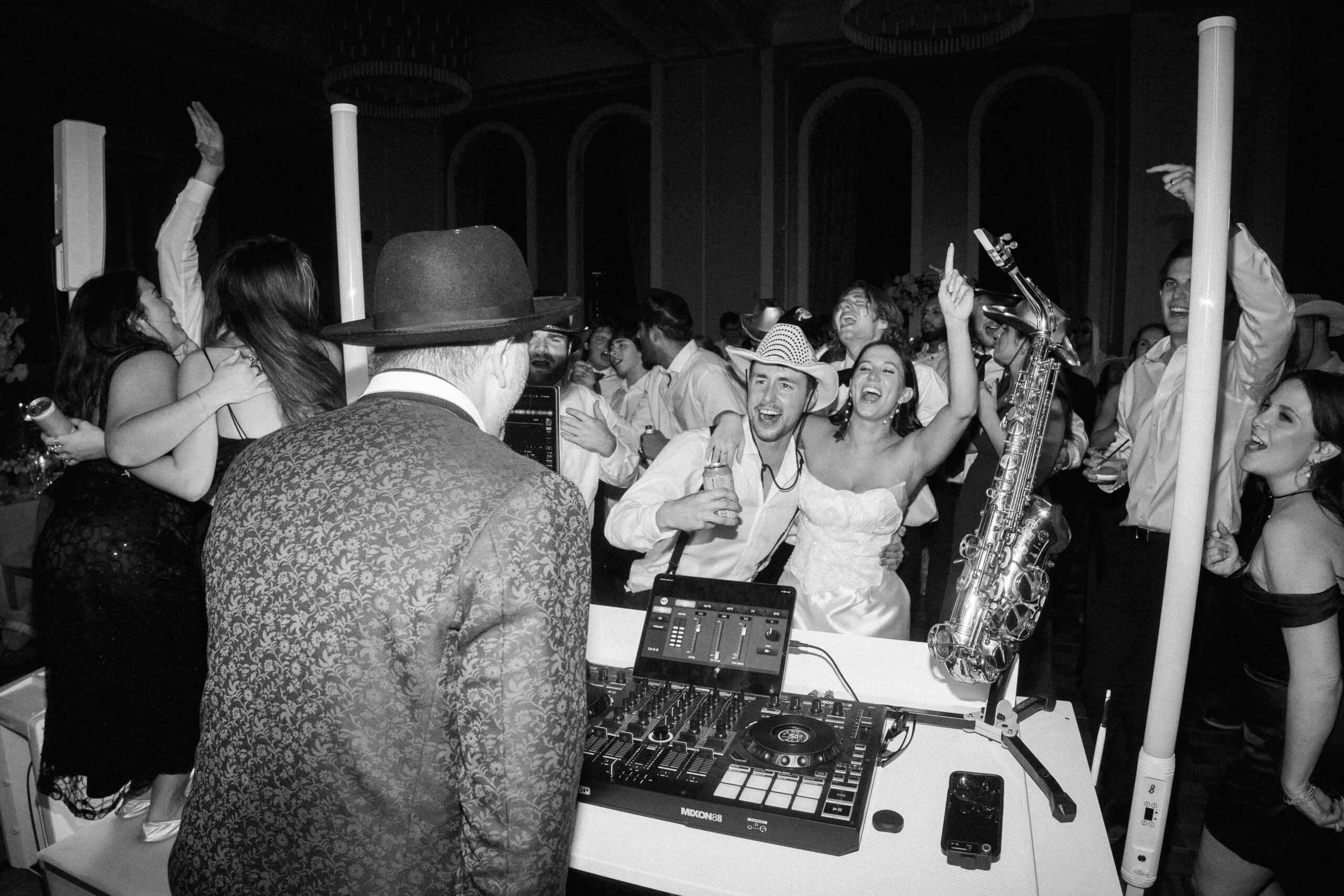
Wedding guests on the dance floor at a Dallas reception. A room that feels like this starts with preparation, not just a playlist.
The full picture
A complete Dallas wedding DJ budget typically covers some combination of the following line items. Some couples need every line. Some need most of them. Almost every couple needs more than one.
- DJ base rate (prep, equipment, reception coverage)
- Ceremony music
- Ceremony sound
- Cocktail hour music
- Reception musicians
- Lighting (dance floor and uplighting)
- Production upgrades
- Rehearsal dinner coverage
Two paths to pricing it
Once the line items are clear, couples have two paths to procurement.
À la carte. Contract a separate provider for each line item. Maximum flexibility on talent and style for each segment. More provider relationships, more contracts, more day-of coordination. Common for couples who want to handpick a specific performer for the ceremony, a different ensemble for cocktail hour, and a separate DJ for the reception.
Consolidated. Combine as many of the line items as possible under a single provider. Fewer contracts, fewer points of failure, one creative vision running through the entire day. Maximum service coherence. Common for couples who want their music and atmosphere to feel cohesive from ceremony through final song, with one provider responsible for the entire arc.
Both paths are legitimate. The right one depends on how the couple wants to organize their day and how cohesive they want the music to feel from start to finish.
The line items above are the real anatomy of a wedding DJ budget in a major metro market. The Dallas wedding DJ prices published on national wedding sites rarely reflect what it actually costs to deliver all of them well. If a quote covers most or all of these line items at the national-average number, it’s worth a second or third consideration.
The goal of this guide was to lay the pieces out clearly so you can build a budget that fits the wedding you actually want, with whichever provider or providers you choose. A wedding DJ budget pulls together more moving pieces than most couples expect, and the right starting point is almost always understanding the parts before evaluating the prices.
Questions Dallas Couples Ask About Wedding DJ Pricing
How much does a wedding DJ cost in Dallas?
Wedding DJ pricing in Dallas typically ranges from about $500 to $15,000, with the right number for any couple depending on the scope of services contracted. Price-shaping factors include the DJ’s years of experience, demand for their calendar, formal musical training, equipment quality, depth of preparation per wedding, whether live performance is part of the offering, day-of labor scope, and annual booking capacity. The averages published on national wedding sites tend to understate the Dallas market because they aggregate national data.
Why are Dallas wedding DJ prices different from national averages?
Dallas wedding DJ prices typically run three to five times higher than national averages because national figures aggregate data from beginner and part-time DJs as well as weddings in lower cost-of-living markets, which pulls the average down. In a major metro like Dallas, full-time professional DJs handle most weddings, and labor and equipment costs are higher than the national baseline. A budget anchored to the national number will fall short of the actual Dallas market.
Why is the price range so wide for wedding DJs?
The price range for wedding DJs is wide because pricing reflects substantial differences in what’s actually being delivered. Key factors include years of professional experience, market demand for the DJ’s calendar, formal musical training, equipment quality and redundancy, depth of preparation per wedding, whether live performance is part of the offering, day-of labor scope, and annual booking capacity. A DJ at $500 and a DJ at $15,000 are not delivering the same scope of service, and the price difference reflects those underlying inputs.
What’s included in a typical wedding DJ quote?
A typical wedding DJ quote covers reception coverage by a DJ. Inside that base rate, the included items typically fall into five categories: pre-event preparation (planning calls, music curation, set list building, coordination with the planner), day-of labor (setup, soundcheck, the reception, breakdown), standard sound equipment for the reception room, MC duties throughout the night, and music management through dinner and the dance set. Items outside the reception itself, such as ceremony music or lighting, are usually separate line items.
What’s often not included in a wedding DJ quote?
Items often not included in a standard wedding DJ quote include ceremony music (selection and curation for prelude, processional, and recessional), ceremony sound (the technical layer of microphones and speakers for the officiant, vows, and readings), cocktail hour music, reception musicians (live instrumentalists who perform alongside the DJ during the reception), lighting (dance floor and uplighting), production upgrades (CO₂, lasers, and similar effects), and rehearsal dinner coverage. These typically appear as separate line items, add-ons to the DJ contract, or contracts with additional providers.
What should a complete wedding entertainment budget cover?
A complete wedding entertainment budget typically covers some combination of: the DJ base rate (prep, equipment, reception coverage), ceremony music, ceremony sound, cocktail hour music, reception musicians, lighting (dance floor and uplighting), production upgrades, and rehearsal dinner coverage. Couples can procure these line items either à la carte from separate providers or consolidated under a single provider. The right combination depends on what the wedding actually needs and how the couple wants to organize the day.
What’s the difference between a $500 DJ and a $15,000 DJ?
The price difference between a $500 DJ and a $15,000 DJ reflects measurable variables in service delivery: years of professional experience, formal musical training, equipment quality and redundancy, depth of preparation per wedding, annual booking volume, day-of labor scope, and whether live performance is included. Different price points represent different operational models, with higher price points typically reflecting more time per wedding, more equipment, and broader day-of coverage. Each model meets different needs.
Is it worth paying more for a wedding DJ?
Whether it’s worth paying more for a wedding DJ depends on how central music, energy, and atmosphere are to the couple’s vision for the wedding. For couples whose vision rests heavily on the dance floor and the flow of the night, a higher-priced DJ typically delivers outcomes that match the investment: deeper preparation, more responsive day-of execution, and broader coverage. For couples treating entertainment as a secondary priority, a lower-priced option may be sufficient. The right number tracks with the priority entertainment holds in the overall wedding vision.
Do I need a wedding DJ for my Dallas wedding?
A wedding DJ is not technically required, but most Dallas weddings benefit significantly from a professional handling music programming, MC duties, and sound. A DJ provides real-time responsiveness to the energy of the room, smooth transitions between key moments, on-the-fly programming based on guest behavior, and the equipment infrastructure to support the entire reception. A DJ also handles announcements and timeline coordination. For weddings beyond an intimate gathering, a professional DJ is the standard approach for both the music and the flow of the evening.
How far in advance should I book a wedding DJ in Dallas?
Most couples should book a Dallas wedding DJ 12 to 18 months before the wedding date for the best calendar availability. Booking 9 to 12 months out is still possible but more risky, since highly demanded DJs and those with smaller annual books may already be filled for peak-season Saturdays in spring and fall. Inquiries beyond 18 months out sit on the far end of the typical range. Couples planning destination weddings or weddings during peak weekends (location specific) should book even earlier.
What questions should I ask a wedding DJ before booking?
Couples should ask a wedding DJ how many weddings they take per year, what their formal musical training is, how they prepare for each wedding, what their day-of labor scope covers, and whether they will personally be the DJ on the wedding day. Other useful questions cover equipment redundancy, communication cadence in the months leading up to the event, how they handle unexpected moments during the reception, and whether live performance is part of their offering. The answers reveal the operational model behind the price.
Should I hire a DJ or a live band for my wedding?
The choice between a DJ and a live band depends on the couple’s musical preferences, budget, venue logistics, and the atmosphere they want for the reception. DJs offer broad song catalogs, flexible volume control, and a smaller equipment footprint. Live bands offer the energy and presence of live performance and the connection that can come from real-time musicianship.
For couples who want both, a DJ who also performs live instruments (such as saxophone) delivers the broad catalog of a DJ along with the energy and connection of live performance, all within one provider and one continuous experience. For a deeper comparison of formats, scope, and pricing, see the dedicated DJ vs. Band guide.
What’s the difference between a DJ and an MC at a wedding?
At most weddings, the DJ and MC are the same person. The DJ handles music programming, equipment, and the technical layer of the reception, while serving as MC for announcements, introductions, and transitions throughout the night. Some weddings do hire a separate MC, often for bi-lingual events or for couples who want a dedicated personality on the microphone. In most Dallas weddings, the DJ doubles as MC, and the role is built into the standard DJ contract.
Can a wedding DJ also play live music?
It’s rare for a wedding DJ to also play a live instrument themselves. When couples want live music alongside the DJ, the standard approach is for the DJ to bring in a freelance instrumentalist for the night. This introduces some unknowns: couples typically don’t meet the freelancer in advance, rehearsal time between the DJ and the freelancer varies, and the cohesiveness of the result depends on how well the two have prepared together.
In the rare case where one person covers both roles, the experience runs differently. Matt Thelen, for instance, performs as both DJ and live saxophonist throughout the reception, layering live performance into the DJ set during peak moments of the night. The same person handles the recorded music and the live element seamlessly within one performance, which keeps the energy continuous and the entertainment integrated under one creative vision.
What makes Matt Thelen different from other Dallas wedding DJs?
Matt Thelen Entertainment differs from other Dallas wedding DJs in several measurable ways. Matt Thelen holds a Music Performance degree from the University of North Texas, has 28 years of musical training and study, and brings 16 years of professional event performance to the work. He serves on the WIPA DFW board and books approximately 30 weddings per year.
The service covers the full wedding entertainment scope under one provider: DJ, MC, ceremony music and sound, cocktail hour music, live saxophone, lighting, production upgrades, and rehearsal dinner.
Past Dallas venues include The Joule, Rosewood Mansion, Hotel Drover, JW Marriott Dallas, Omni Dallas, Knotting Hill Place, Hotel Zaza, The Crescent Hotel, The Crescent Club, Dallas Arboretum, and Trinity River Audubon. Corporate stages include Fotona and Southwest Airlines, with destination weddings performed at Montage Palmetto Bluff and numerous destinations across the country.
Featured Dallas Wedding Venues
Matt Thelen has performed at some of the city’s most iconic spaces:
- The Joule, Modern glamour meets high-energy nightlife vibes.
- Rosewood Mansion, Historic estate with timeless Dallas charm and old-world refinement.
- Hotel Drover, Rustic elegance with room to party.
- JW Marriott Dallas, Timeless hospitality with cutting-edge amenities.
- Omni Dallas, Grand spaces built for full-scale production.
- Knotting Hill Place, Grand fairytale estate built for full-scale celebrations.
- Hotel Zaza, Chic boutique hotel with bold, eclectic style.
- The Crescent Hotel, Sophisticated Uptown venue with upscale elegance.
- The Crescent Club, Skyline views and a polished private-club feel.
- Dallas Arboretum, Lush gardens and serene lakeside backdrops.
- Trinity River Audubon, Scenic nature setting with stunning views.
Related Questions & Resources
Still exploring? These pages go deeper:


