

Back to Home Page
Finding the Perfect Fit for Your Celebration
DJ vs Band for Weddings
By Matt Thelen · Music Performance Degree · WIPA Board of Directors · Performing since 1998
Last updated: June 2026
At a Glance
Key Takeaways
- A wedding DJ provides unlimited song selection, continuous music with no breaks, real-time room reading, and full MC and timeline management to keep your wedding running smoothly from start to finish.
- A live wedding band creates visual stage energy and a concert atmosphere, but typically costs two to four times more than a DJ and requires 15 to 20 minute breaks every 45 minutes during the reception itself.
- The hybrid DJ and live saxophone format combines the strengths of both: the versatility and control of a DJ with the emotional presence of a live musician, delivered by a single performer.
- For Dallas weddings, the decision depends on your priorities: budget flexibility, song variety, crowd energy, and how much real-time control you want over the atmosphere.
Table of Contents
- The Real Question Behind DJ vs Band
- What a Wedding DJ Actually Does (And Why It Matters)
- What a Live Wedding Band Does Well
- When a Band Really Is the Better Choice
- The Honest Downsides of a Live Wedding Band
- Why You Don’t Have to Choose: The DJ and Live Saxophone Experience
- Wedding DJ vs Band Cost in Dallas
- How to Decide What’s Right for Your Celebration
- Questions Couples Ask About DJs vs Bands for Weddings
The Real Question Behind DJ vs Band
Most couples start the DJ vs band conversation here because they want the best possible energy at their reception. That’s the right instinct. But the question “DJ or band?” often misses the deeper question underneath it.
What you’re really asking is: Who do I trust to read a room full of the most important people in my life and make the night feel exactly right for everyone in the room?
That answer depends on what you value most. Do you want limitless song selection and precise control over the energy arc of the entire evening? Or do you want the visual spectacle of musicians on a stage? Do you want continuous, unbroken momentum on the dance floor? Or are you comfortable with breaks between sets?
There’s no wrong answer. But there is a third option that most comparison guides leave out entirely, and I’ll get to that.
First, let me give you an honest look at both sides of the DJ vs band question. I’ve been studying and performing music for 28 years and performing at weddings and events for 16 of those. I hold a Music Performance degree from the University of North Texas. I also serve on the Board of Directors for WIPA Dallas-Fort Worth, the local chapter of the Wedding International Professionals Association.
What a Wedding DJ Actually Does (And Why It Matters)
In the DJ vs band comparison, most couples think of a wedding DJ as someone who plays music. That’s like saying a chef is someone who cooks food. Technically true. Missing the point entirely.
A skilled wedding DJ is the architect of your entire evening.
Every transition, every energy shift, every moment where the room needs to move from tears to laughter to dancing. That is live performance happening in real time, every single minute of the evening.
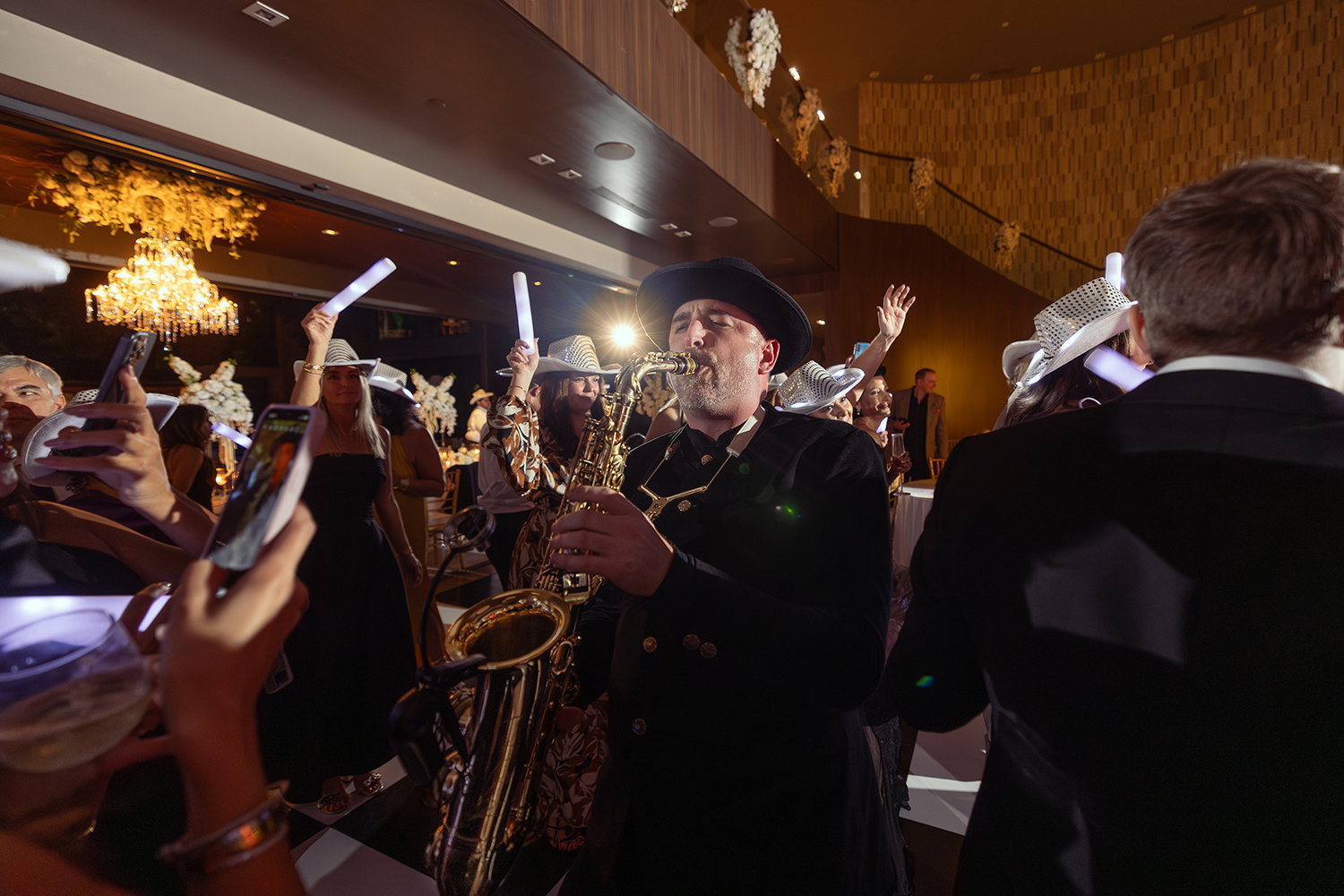
Here’s what a strong wedding DJ brings that often gets overlooked:
Unlimited music selection. A DJ has access to every genre, every era, every deep cut your grandmother loves and every deep cut your college friends absolutely need to hear at your reception.
There are no rehearsal limitations. No songs the band “doesn’t do.” If your father-daughter dance is a song recorded in 1973 that nobody else at the wedding has ever heard, a DJ plays the original. A band plays their interpretation of it, if they know it at all.
Continuous, unbroken energy. No set breaks. No fifteen-minute gaps where guests drift away from the dance floor and never come back. A DJ builds momentum across three hours and never lets the room cool down. That matters more than most people realize until they have experienced the alternative firsthand at someone else’s reception.
Real-time room reading. This is the part that separates a great DJ from a good one. When the dance floor thins, a trained DJ feels it immediately. The adjustment happens in seconds, not songs. A tempo shift. A genre pivot. A track that pulls a specific group of guests back to the floor because the DJ has been watching who responds to what all night. That kind of real-time musical intelligence comes from training and experience, and it’s invisible when done well.
One couple I worked with at Hotel Drover put it this way: “Despite giving him very little direction, he somehow delivered exactly what we wanted, almost as if he could read our minds.” That’s what real-time room reading looks like from the guest side of the dance floor.
MC and timeline management. A DJ is also your master of ceremonies. Introductions, toasts, special dances, cake cutting, bouquet toss, send-off. Every transition coordinated with your planner down to the minute. With a band, you typically need a separate emcee or rely on the bandleader, whose primary focus is performing, not managing your timeline.
Volume precision. During dinner, your DJ can bring the energy down to a whisper so guests can talk across the table. During the dance party, the room fills with sound.
That granular control over volume, EQ, and spatial audio design matters enormously in venues with different room configurations, cocktail-to-ballroom transitions, and venue noise restrictions you might encounter on the night.
What a Live Wedding Band Does Well
On the band side of the DJ vs band conversation, a great band does something a DJ cannot replicate: they put live musicians on a stage, and the visual energy of that live performance fundamentally changes the energy of the entire reception room.
There’s a reason concerts feel different than listening to an album. Watching a guitarist lean into a solo, a horn section stand and blast, a vocalist pour everything into a bridge. That physical presence creates an atmosphere that’s genuinely electric.
Stage energy. A band transforms your reception into a live concert. For guests who respond to visual spectacle, there’s nothing quite like it. The stage becomes a focal point. The musicians become part of the show.
A unique sonic fingerprint. Every band sounds different. Their arrangement of a song is their version, and that distinctiveness can give your reception a character that feels entirely its own.
The “wow” factor for certain crowds. If your guest list skews toward people who love live music, who go to concerts regularly, who respond to the energy of musicians performing in the room, a band delivers on that in a way that a standard DJ setup does not.
I have deep respect for what the best bands can do. When a band is right for the couple and the crowd, it’s powerful.
When a Band Really Is the Better Choice
I’m going to be direct here, because this page is only worth reading if it’s honest.
In the DJ vs band decision, there are couples and celebrations where a band is the right call. If any of these describe your vision, you should lean toward booking a band and feel really good about that decision:
Your taste runs toward classic wedding standards. If your dream setlist is mostly familiar Top 40 hits, Motown, classic rock, and the songs that get played at every wedding reception, a good band can deliver those with genuine energy and flair. Bands genuinely thrive across that wide range of classic wedding repertoire couples love.
You want a sit-down concert atmosphere. Some couples envision a reception where guests enjoy the music from their seats more than the dance floor. If the vibe is more dinner-and-a-show than four-hour dance party, a band suits that beautifully.
The spotlight on entertainment feels right. With a band, the performers are a visual centerpiece. If you want the entertainment to command attention and become part of the decor, a band does that naturally.
Group choreography is part of the fun. Bands are built for those classic wedding moments: the Cupid Shuffle, the Cha Cha Slide, the coordinated group dances that some crowds absolutely love. If your guest list is the kind that lives for that energy, a band feeds it.
The Honest Downsides of a Live Wedding Band
Here’s where I owe you the full picture on the band side of the DJ vs band debate, because these are the things most comparison guides gloss over.
Mandatory breaks. Every band takes breaks, typically 15 to 20 minutes every 45 minutes of performance. That is not optional at all, because musicians genuinely need time to rest before continuing.
And those breaks are where momentum dies. Guests sit down. Conversations start. And getting a room full of people back on a dance floor after a lull is exponentially harder than keeping them there in the first place. Some bands play recorded music during breaks, but it is never the same energy as live performance in the actual room.
Physical footprint. A six to ten piece band needs a stage, instruments, monitors, and space. In Dallas ballrooms with tight floor plans, that setup can eat into your dance floor and guest seating. In some of the rooms I play most often, real estate is everything, and every square foot of dance floor truly matters.
Inconsistent personnel. The band you saw at the showcase or the wedding you attended may not be the same musicians who show up at yours. Most Dallas wedding bands rotate players.
The vocalist you fell in love with might have a conflict. The guitarist who made the demo reel might not be available on your date. The core sound you booked can shift.
Limited repertoire. A band can only play songs they’ve rehearsed. Request a deep cut from your college years or a song in a genre outside their wheelhouse, and the answer is often no. Or worse, the answer is yes and the performance does not capture what you loved about the original recording in the first place.
No dedicated emcee. The bandleader is a musician first. Announcements, timeline management, and coordination with your planner are secondary to performing. Some bandleaders are excellent MCs. Many are not. And on a night where timing matters for every vendor in the room, that’s a gap.
Rigid set structure. A band follows a setlist. When the room shifts, when a song isn’t landing, when the energy needs to pivot, a band can’t switch tracks in ten seconds.
They finish the song. They regroup. The adjustment is slower, and sometimes the moment has already passed.
Cost. In the Dallas market, a strong wedding band typically represents a significantly higher investment than a DJ. That’s not a judgment on value. Great bands are worth what they charge. But the gap is real, and for many couples, those same dollars could serve their wedding celebration in a much more meaningful way.
Why You Don’t Have to Choose: The DJ and Live Saxophone Experience
Beyond the DJ vs band binary, there’s a third option worth considering, and it’s the one I’ve spent my career building.
A hybrid DJ and live saxophone experience takes the strengths of both formats and combines them into a single, seamless experience.
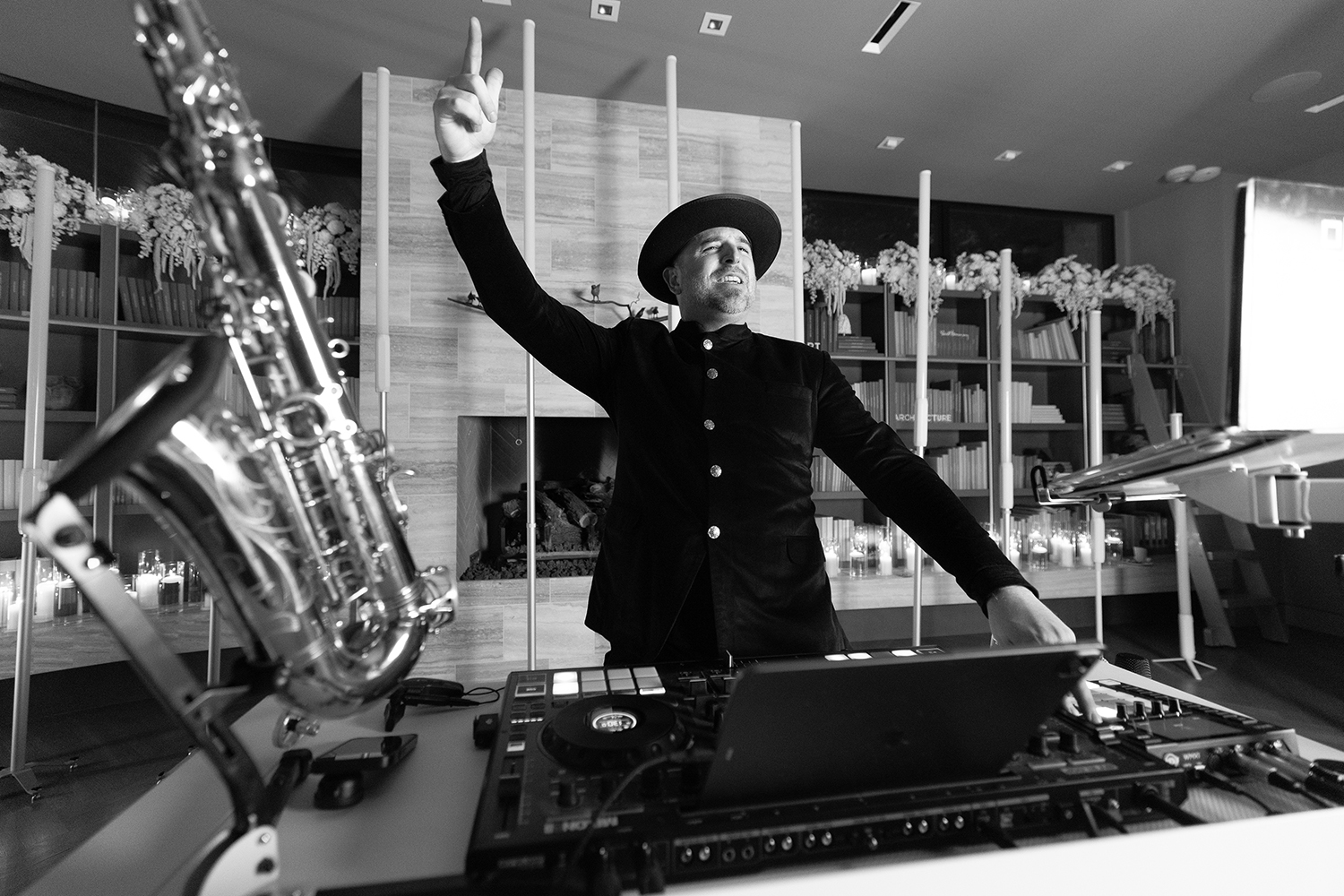
Here’s what that actually looks like at a wedding:
During the ceremony, live sax sets the emotional tone for the processional, or curated music designed to match the arc of the moment. Every selection mapped to your specific ceremony structure.
During cocktail hour, a live sax and DJ set gives the room warm, sophisticated energy. A real performance that draws guests in and sets the tone for the evening ahead.
During dinner, the atmosphere shifts in real time. Genre, tempo, and volume adjust based on what the room needs, not what a pre-built band setlist arbitrarily dictates from the start of the evening.
During the reception, everything converges. DJ mixing blended with live saxophone, intelligent lighting design, and production elements when the moment calls for it.
The energy builds and breathes and never drops. No breaks. No lulls. No momentum lost.
That continuous energy tends to be what guests remember. One couple I worked with at The Crescent Club described it as “teenagers and great aunts all dancing for hours,” which is the kind of multigenerational floor that’s hard to build when the music stops abruptly every 45 minutes during the reception itself.
What makes this format work isn’t the saxophone on its own.
It’s the training and preparation behind it. Twenty-eight years of musical study, sixteen years of performing at weddings, and the ability to read a room in real time while managing every technical and creative element of the evening.
The person you meet during planning, the person who spends months learning your music, your story, and your vision, is the same person who walks into your venue and performs every note.
Wedding DJ vs Band Cost in Dallas
Couples planning Dallas weddings consistently search for cost comparisons between wedding DJs and bands.
The honest DJ vs band answer is that the range depends entirely on what’s included in the service.
In the Dallas market, the investment for these categories reflects fundamentally different scopes of work:
A wedding DJ can range from a basic service with standard equipment to a full-production experience that includes months of custom music planning, live performance elements, MC duties, intelligent lighting, and real-time sound design. The depth of preparation, the performer’s training, and the scope of the experience all shape the investment.
A live wedding band typically represents a higher cost due to the number of musicians, rehearsal time, equipment, transportation, and coordination involved. A band with six to ten members has six to ten people to pay, feed, and manage. That’s reflected in the price.
A hybrid DJ and live saxophone experience falls between the two, but it’s a different category altogether. You’re investing in a single performer with formal musical training who delivers live performance, DJ mixing, MC work, and full event production. The months of collaborative planning that happen before the event are part of that investment.
My recommendation is the same one I’d give to a friend: before you compare numbers, get clear on the experience you actually want. Then talk to the people you’re considering. Ask what’s included. Ask what the planning process looks like. Ask who shows up on your wedding day. The right investment becomes obvious once you understand what each option actually delivers.
For more on how pricing works for a DJ and live saxophone experience, visit the Wedding DJ Prices in Dallas page.
How to Decide What’s Right for Your Celebration
The best way to think about this decision isn’t DJ vs band. It’s about what matters most to you and the people in the room.
If variety and flexibility matter most, you want a wedding DJ. Unlimited song selection, real-time adjustments, unbroken energy, and precise control over every moment of the night.
If visual stage presence matters most, you want a band. Live musicians performing in the room create a visual spectacle that completely transforms the entire reception atmosphere.
If you want both, a hybrid DJ and live saxophone experience gives you the versatility, control, and continuous momentum of a DJ with the emotional depth and live energy of a musician performing alongside the mix.
And here’s a question worth asking that often gets overlooked: How important is the planning process?
Because the performance is only the visible 20% of what a great entertainment experience looks like. The other 80% is the months of work before the music starts. Discovery conversations. Music curation built around your story and your crowd. Timeline coordination with your planner. Creative sessions that map the emotional arc of the entire evening.
That process is what turns a good night into one your guests talk about for years. And it’s available with any format you choose, but the depth of that process should be part of your decision alongside the cost and the format.
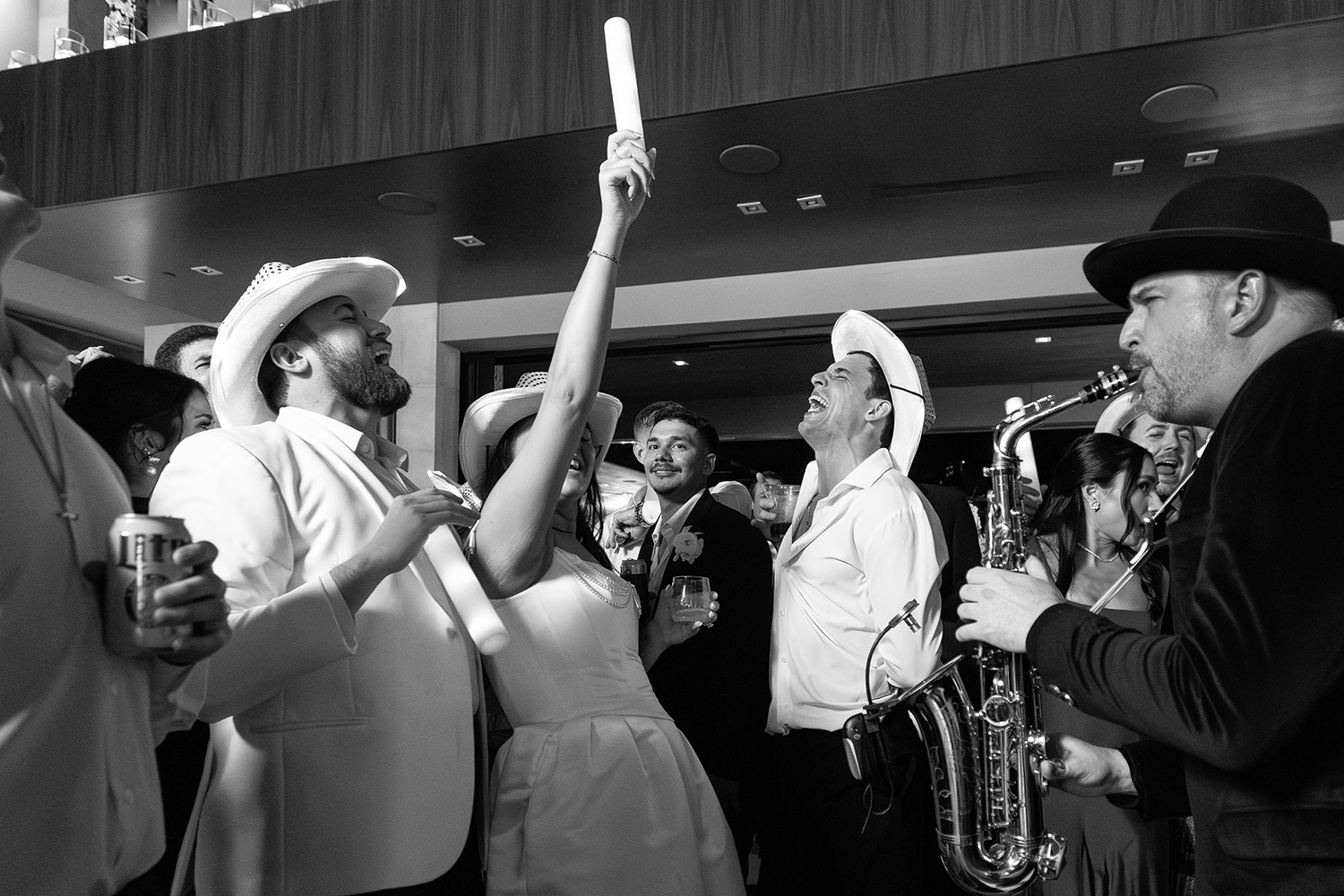
The best next step in your DJ vs band decision is always a conversation. Talk to the DJs and bands you’re considering. Ask about their process. Ask what happens in the months before the event, not just the night of. The answers will tell you everything.
Questions Couples Ask About DJs vs Bands for Weddings
These are the most common questions couples ask in the DJ vs band conversation.
Is a DJ or a band better for a wedding?
Neither is universally better. A wedding DJ offers unlimited song selection, continuous music with no breaks, precise volume control, real-time room reading, and MC services. A live wedding band provides stage presence, visual energy, and a concert atmosphere.
The right choice depends on your priorities. If variety, flexibility, and nonstop dance floor energy matter most, a DJ is typically the stronger choice. If visual spectacle and a unique live performance atmosphere are your priority, a band may be right. A hybrid DJ and live saxophone experience, like what Matt Thelen Entertainment provides, combines the strengths of both formats into one single seamless performance experience throughout the entire wedding evening.
Can you have a DJ and a band at a wedding?
Yes. Some couples hire both a DJ and a band for different parts of the evening, such as a band for the first hour and a DJ for the rest of the reception. However, this approach doubles the cost, requires coordinating two vendors, and can create awkward transitions between formats. A more integrated alternative is a hybrid DJ and live musician experience, where one performer delivers both DJ mixing and live instrumental performance throughout the entire event with no gaps or transitions between vendors.
How much more does a wedding band cost than a DJ?
In the Dallas market, a live wedding band typically costs significantly more than a wedding DJ. The higher investment reflects multiple musicians, rehearsal time, equipment, and transportation. A hybrid DJ and live saxophone experience represents a middle ground in cost while delivering elements of both formats. The exact investment depends on the scope of service, the number of musicians, and how much custom planning is included. For more on DJ pricing, visit the Wedding DJ Prices in Dallas page.
What are the pros and cons of a wedding DJ?
A wedding DJ offers unlimited song selection across every genre and era, continuous music with no mandatory breaks, real-time room reading and energy adjustments, MC and timeline management, and precise volume control for different phases of the evening.
Potential drawbacks include the absence of live musicians on stage and a more understated visual presence compared to a full band. However, a DJ with live performance elements, such as a hybrid DJ and saxophone experience, addresses both of those limitations while maintaining all the advantages of the DJ format.
Do wedding bands play requests?
Most wedding bands can accommodate some requests, but only if the songs are in their rehearsed repertoire. Unlike a DJ who has access to virtually any recorded song, a band is limited to what they’ve prepared. Complex or obscure requests may not be possible on short notice. If having specific songs played as the original recordings is important to you, a DJ or hybrid DJ and live musician experience offers significantly more flexibility for your specific song requests on the big day.
What is a DJ and saxophone duo?
A DJ and saxophone duo combines a professional DJ with a live saxophonist performing simultaneously. Matt Thelen Entertainment takes this format further by having a single performer handle both roles. Matt Thelen is both the DJ and the saxophonist, holding a Music Performance degree from the University of North Texas, 28 years of musical experience, and 16 years of performing at weddings and events. This means one creative vision controls the music, the live performance, the MC duties, the lighting, and the timeline, with no coordination gaps between separate performers.
Can a DJ play ceremony music?
Yes. An experienced wedding DJ can provide music for the entire ceremony, including prelude, processional, and recessional selections. Matt Thelen Entertainment also offers live saxophone performance during the ceremony, creating an intimate, emotionally resonant atmosphere. Every song is mapped to the specific structure of your ceremony in advance through our collaborative pre-wedding planning process together over many months.
What happens when a wedding band takes a break?
Wedding bands typically take 15 to 20 minute breaks every 45 minutes of performance. During these breaks, the band either plays recorded music through their PA system or the dance floor goes silent. This interruption can significantly impact dance floor momentum, as guests who sit down during a break are much harder to bring back to the floor than guests who never left. A wedding DJ or hybrid DJ and saxophone performer plays continuously with no mandatory breaks, maintaining energy throughout the reception.
What makes a hybrid DJ and saxophone experience different from hiring a DJ and a separate musician?
When a DJ and a separate musician are hired independently, they’re two people with two creative visions trying to coordinate in real time. The result can feel disjointed.
Matt Thelen Entertainment’s hybrid model is different because one performer controls everything: the DJ mixing, the live saxophone, the MC duties, the lighting, and the timeline.
Matt Thelen holds a Music Performance degree from the University of North Texas, with 28 years of musical training and 16 years of performing the hybrid DJ and saxophone format at weddings and events. The planning process begins months before the event with collaborative music discovery, so every creative decision flows from a single artistic vision.
- The Joule - Modern glamour meets high-energy nightlife vibes.
- Omni Dallas - Grand spaces perfect for full-scale production.
- Hotel Drover - Rustic elegance with room to party.
- JW Marriott Dallas - Timeless luxury with cutting-edge amenities.
- Rosewood Mansion - Historic luxury with timeless Dallas charm.
- Knotting Hill Place - Grand, fairytale estate perfect for lavish weddings.
- Hotel Zaza - Chic boutique hotel with bold, eclectic style.
- The Crescent Hotel - Sophisticated Uptown venue with upscale elegance.
- Dallas Arboretum - Lush gardens and serene lakeside backdrops.
- Trinity River Audubon - Scenic nature setting with stunning views.
Featured Dallas Venues
I’ve performed at some of the city’s most iconic spaces:


